Magpie Injury Behaviour


Some time ago while driving on a country road close to my home in East Gippsland I hit a Magpie head on. I stopped and looked back. Immediately the other members of the Magpie family flew down to the dead or injured bird and began pecking at it vigorously as it lay there prone on the road.

This experience has always remained a mystery. One can only speculate as to the family’s intentions.

Chris Shaw
Sent from my iPhone


Birding-Aus mailing list

Birding-Aus@birding-aus.org

To change settings or unsubscribe visit:

birding-aus.org/mailman/listinfo/birding-aus_birding-aus.org
Magpie killed by wind?

Driving to Grafton today, saw a magpie killed on M1 – 110kph. Luckily, it went behind the vehicle in front. I thought it was lucky because I wasn’t close enough to hit it. 
However, just as it came out from behind the front vehicle, it exploded into a whole lot of feathers and slammed into the ground.
It hadn’t made contact with the front vehicle, but the wind (slipstream) that hit it as it emerged from behind must have been the equivalent of a physical strike.
Probably the saddest thing was seeing, in the rear-vision mirror, another magpie fly down to it. 
So, speed kills – even without contact.
Peter Morgan

                 The conservation battle is never finally won; the development battle is.
       

Nesting of Whistling Kites

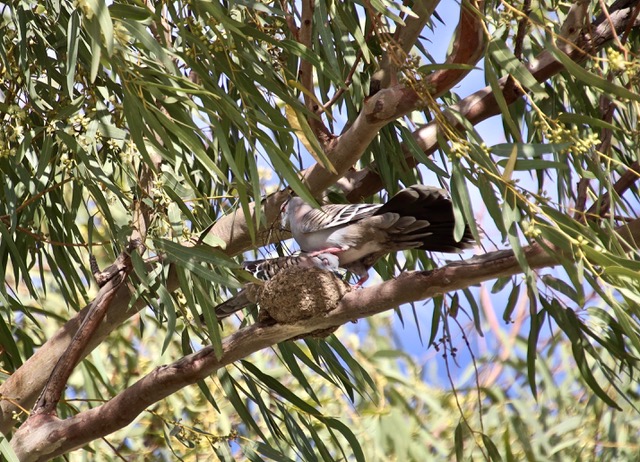
A couple of months ago we saw a Whistling Kite carrying sticks into a copse of Angophoras next to our house,  Eventually we saw the nest, clearly visible from our deck.  The birds started sitting in it and (after a pause of about 3 days during a very gusty period) a bird occupied the nest for most of September.  Then they left the nest and after a couple of days were seen carrying sticks to a different part of the copse.  I have yet to spot the (presumed) new nest.   Yesterday a bird spent most of the day sitting in the old nest.  
Are they in fact laying eggs in this process or just practicing building a nest?

Vale Paul Oliver

Some of the old-timers on birding-aus will remember the occasional contributions from Paul Oliver. Paul grew up in the UK and went touring in Africa in his 20s. As often happens in Africa, something bit him and he stayed to settle in Arusha Tanzania. He was a pioneer in the modern safari industry and developed from scratch one of the best camps in Tanzania – Oliver’s Camp in Tarangire National Park. He ran birding safaris for people from all over the world and had a great reputation as a naturalist and teacher to many native Tanzanians. He met his partner Lala – an Australian – and has spent many years since “with one foot in Tanzanian and the other in Australia”. His Australia home was in Far North Qld (Kuranda I think).

I met Paul when my wife and I went to Arusha to live in March 2020 and he offered us a house to rent. We found ourselves in a blissfully peaceful oasis of native trees, full of birds. The house was quirky (like the owner) and had lots of beer and wine bottles embedded in the walls and bits of old landrovers scattered around as structural features. Paul arrived prior to a safari and we quickly became mates as he was very generous with his local birding knowledge and vast number of stories of the Tanzanian bush. He amazingly let me look after his excellent library of African natural history books.

Unfortunately he also arrived with a gut ache which, after many tests in three countries, turned out to be cancer. He returned to live in the UK for treatment and enjoyed a year or so looking for the birds and wild places of his youth. Sadly Paul passed away yesterday. He was just 65.


Birding-Aus mailing list

Birding-Aus@birding-aus.org

To change settings or unsubscribe visit:

birding-aus.org/mailman/listinfo/birding-aus_birding-aus.org

Rosella deaths

We have 2 nesting boxes in our back yard and over the last 3 years Eastern Rosellas have raised chicks in one of the boxes. On 4 October there were 4 bonny, but still naked, chicks about 100mm long in one of the boxes. They were receiving constant attention from both parents. We were away on the 6 and 7 October but on 8 October noticed that a pair of Rainbow Lorikeets were spending a lot of time around and near the box, landing on the perch and peering inside. Whilst doing so they were making harsh repetitive calls.

We had seen the male rosella chase lorikeets away from the area around the nesting box on several occasions. On one occasion we saw a Rainbow Lorikeet enter the nesting box which, we believed, contained the female rosella and 4 chicks. It became obvious by 9 October that the rosellas had abandoned the box. On 10 October we saw both a lorikeet and the rosella enter the box for a short period of time.

Today (11th) I took the box down to find 4 dead chicks well consumed by numerous maggots.

Rainbow Lorikeets are constant residents and have never previously shown any interest in the nesting boxes or the rosellas. Over the last few years we believe they have nested in an old date palm next door. 
Has anyone observed lorikeet predation of rosella chicks? Is this a common event? Or, is there some other explanation?   
Would like to hear your opinions.
Thanks  Geoff

Les Chandler: veteran bird photographer

A nice item on ABC TV Landline just now, about Les Chandler, who was a soldier in WWI, but on his return home for years did some excellent bird photography, mainly it seems around the mallee regions. This was long ago when photography was difficult. It shows what has happened with his collection. He died in 1980, age 92.


Philip


Birdpedia – Australia – Weekly Digest

The following is a digest of Sightings Reported on Birdpedia for the period Monday, September 27, 2021 to Sunday, October 3, 2021:

Area: SA

Location: Newland Head CP

Elegant Parrot (Neophema elegans) (30) Large flock were feeding along the track and perching on the fences as we drove to the northern area of the park

Reported by: Winston Syson on Friday, October 1, 2021

———————————————

Need more information about a sighting? Login and contact the poster directly.

Receive sightings via email or SMS immediately they are posted.

Not a member of Birdpedia? Membership is free and gives you access to information for over 230 countries.

To sign up go to the Birdpedia Web Site (www.birdpedia.com/).

To find out more about Birdpedia and what it can do for you, see ‘What is Birdpedia?’

———————————————

IMPORTANT NOTICE: This e-mail message is intended to be received only by persons entitled to receive the confidential information it may contain. E-mail messages to clients of Birdpedia may contain information that is confidential and legally privileged. Please do not read, copy, forward, or store this message unless you are an intended recipient of it. If you have received this message in error, please forward it to the sender and delete it completely from your computer system.


Birding-Aus mailing list

Birding-Aus@birding-aus.org

To change settings or unsubscribe visit:

birding-aus.org/mailman/listinfo/birding-aus_birding-aus.org