On Thu, 28 Feb 2019 at 09:22, Bill Stent <billstent@gmail.com> wrote:Hi all, Bill here
I’m preparing a Facebook post about how LBCs dig into hard packed dirt, and
I discovered that I don’t have a photo of one at hand (I know I’ve taken
some quite decent ones before but they’re … somewhere)Does anyone have a photo of a Long-billed Corella, preferably on the ground,
that they can send me to use? I’ll give credit for the photo, of course.Many thanks!
<HR>
<BR> Birding-Aus mailing list
<BR> Birding-Aus@birding-aus.org
<BR> To change settings or unsubscribe visit:
<BR> http://birding-aus.org/mailman/listinfo/birding-aus_birding-aus.org
</HR>
Month: February 2019
Photo of a Long-billed Corella?
Hi all, Bill here
I’m preparing a Facebook post about how LBCs dig into hard packed dirt, and
I discovered that I don’t have a photo of one at hand (I know I’ve taken
some quite decent ones before but they’re … somewhere)
Does anyone have a photo of a Long-billed Corella, preferably on the ground,
that they can send me to use? I’ll give credit for the photo, of course.
Many thanks!
Birding-Aus mailing list
Birding-Aus@birding-aus.org
To change settings or unsubscribe visit:
birding-aus.org/mailman/listinfo/birding-aus_birding-aus.org
Turkey Talk and Jabiru
All that opinion is fair enough. The Jabiru is an interesting story. I think
we all know it but here it is again. The point being that the Jabiru is one
species of bird, only from South America. The name comes from a TupiGuaraní
language and means “swollen neck”, a feature not shared with our bird, so
the word is clearly wrong. I suggest the word applied here has the very
unfortunate aspect of easily sounding like an Australian name (like kangaroo
that jabs at its food), so it has easily been transferred here, mostly in
ignorance that it is wrong even if understood by almost everyone. If I talk
of a Jabiru I am certainly talking about the South American bird, which I
never have and never will encounter. The complication is that “Stork” is
also surely originally a specific species of bird from Europe and Africa.
The difference is that over time “Stork” has become a group name applied to
other birds including our species, but Jabiru has not. I suggest
“Black-necked Stork” is only equally “ugly, ungainly and totally unromantic”
as are 90% + of bird names around the world. It is entirely typical and it
is a good name on that basis (Satin Stork is nicer). Similar to “cuckoo”,
surely originally just for one species (of Europe) but now a group name. It
is only quirks of history and colonialism as to which former English species
names become group names and history only goes forward. Is there a reason
why “Jabiru” is not also available as a group name? Although I don’t see any
value of doing that, other than in the illusion of sounding like it has
original Australian culture value and thus validating an error. To my mind
this would be regrettable. But we are all happy with “Magpie”, so there I
have hypocrisy in that common bird. “Torresian Imperial Pigeon” is entirely
sensible in creating a very useful link to all the other birds in a group
called Imperial Pigeon (whatever that is), something that is lost in just
using “Torres Strait Pigeon”.
Philip
—–Original Message—–
From: Birding-Aus [birding-aus.org/mailman/listinfo/birding-aus_birding-aus.org
Turkey Talk
The beauty of the English language is its flexibility. If a word or name is commonly understood it can be used.
Ornithology has it’s own Scientific Names which are only changeable
through Scientific process and publication. These are generally accepted world-wide so readers know precisely which bird is referred to. (Pardon the grammar).
Birdwatchers, in Australia at least, have standardised Common Names as well, dictated originally by top twitchers, most of them British. In the process we lost some wonderful common names, understood by all Australian birdos. Eg “Jabiru”, (because this Portuguese name also refers to a South American Stork, never likely to be seen wild in Australia or confused with our Jabiru by anyone literate), replaced by “Black-necked Stork” , to my mind, ugly, ungainly and totally unromantic.
Similarly, “Torres Strait Pigeon” became “Torresian Imperial Pigeon” ; we lose an Oz name so that some intellectually straight jacketed pseudo -scientist can inflict their unnecessary pseudo-science on our historic Australian colloquial bird names.
Earlier bird-books quoted the common names as well as the Scientific ones. In themselves they made interesting reading.
As the Turkey discussion demonstrates, our original names reflect history and geography. “Lumping” of Scientific names is being modified as sub specific differences are revealed.
Perhaps Brush Turkeys dust bathe and Bush Turkeys don’t. Just by looking into the name differences we learn more about birds.
Birding names should not be sterilised, even at the alter of International Twitching tours. If in doubt use the Scientific names.
Sincerely
Michael Hunter
Sent from my iPhone
Birding-Aus mailing list
Birding-Aus@birding-aus.org
To change settings or unsubscribe visit:
birding-aus.org/mailman/listinfo/birding-aus_birding-aus.org
Turkey dust bathing
G’day
I’ve been coming across some odd holes in the bush tracks in my neighbourhood. They are about 30 cm across and 15 cm deep [not your average bandicoot or pig excavation].
I came across a female looking bush turkey sitting in a fresh hole, dug about 100 metres from the nearest active mound. It looked rather dusty, and I suspect it was dusting. Is this a common turkey behaviour?
Regards, Laurie.
Birding-Aus mailing list
Birding-Aus@birding-aus.org
To change settings or unsubscribe visit:
birding-aus.org/mailman/listinfo/birding-aus_birding-aus.org
Needletails
New addition to the Balcony List, but I've only been here a couple of months.
Russell Woodford
Birdpedia – Australia – Weekly Digest
The following is a digest of Sightings Reported on Birdpedia for the period Monday, February 25, 2019 to Sunday, March 3, 2019:
Area: SA
Location: Gregory St Port Elliot
Fork-tailed Swift (Apus pacificus) (6) Birds came over my house very high and heading East.
Reported by: Winston Syson on Monday, February 25, 2019
———————————————
Date: Wednesday, February 27, 2019
Location: Goolwa
Fork-tailed Swift (Apus pacificus) (30) Birds were hawking over greater Goolwa. seen by me from Goolwa Bowling club.
Reported by: Winston Syson on Wednesday, February 27, 2019
———————————————
Need more information about a sighting? Login and contact the poster directly.
Receive sightings via email or SMS immediately they are posted.
Not a member of Birdpedia? Membership is free and gives you access to information for over 230 countries.
To sign up go to the Birdpedia Web Site (www.birdpedia.com/).
To find out more about Birdpedia and what it can do for you, see ‘What is Birdpedia?’
———————————————
IMPORTANT NOTICE: This e-mail message is intended to be received only by persons entitled to receive the confidential information it may contain. E-mail messages to clients of Birdpedia may contain information that is confidential and legally privileged. Please do not read, copy, forward, or store this message unless you are an intended recipient of it. If you have received this message in error, please forward it to the sender and delete it completely from your computer system.
Birding-Aus mailing list
Birding-Aus@birding-aus.org
To change settings or unsubscribe visit:
birding-aus.org/mailman/listinfo/birding-aus_birding-aus.org
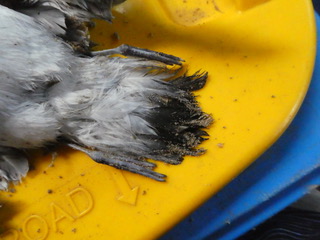
Help please, seabird
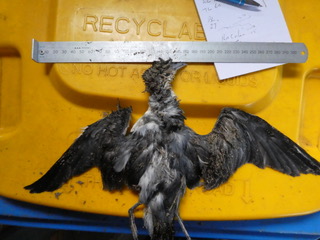
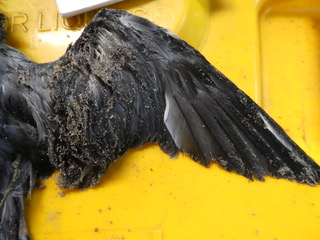
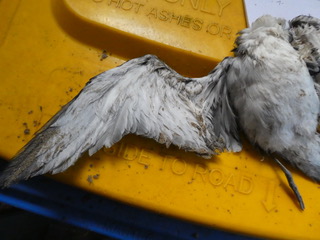
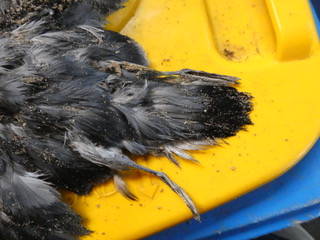
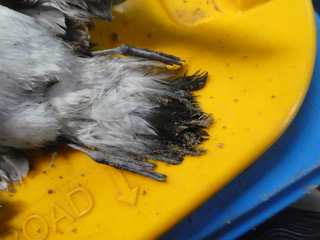
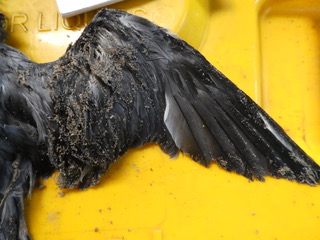
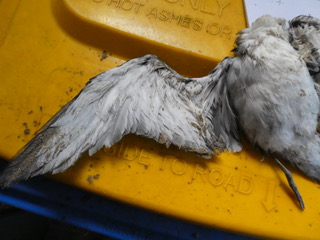
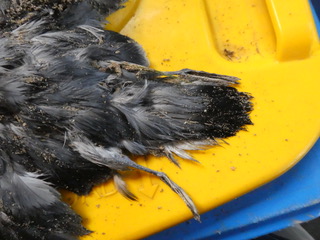
Really? HANZAB and field guide drawings match colour (or shade) for Common Diving Petrel as dark grey above and pale grey below. Not “black & white”, although at sea I guess they could look black & white. I have only ever seen Common Diving Petrel on one day and not recently but they are not that much different in colour above & below as is this bird, although rather more pale than this photo shows. I have like most of us, seen hundreds of dead Short-tailed Shearwaters and thousands of live ones. The shape looks wrong to me for a Short-tailed Shearwater (wings not narrow enough) and why would someone ask about Short-tailed Shearwater? Surely they are found dead in large numbers. Using HANZAB: Weight of Short-tailed Shearwater given as 480 to 800 grams and Common Diving Petrel given as 110 to 150 grams. Weight of this specimen given as 77 g. I suggest that being underweight is consistent with being dead, but not by that much to match a recently dead shearwater. HANZAB: Wing span of Short-tailed Shearwater given as 95 to 100 cm and Common Diving Petrel given as 33 to 38 cm. Look at the (hopefully) 30 cm ruler, if this is a shearwater, the wing span should be equal to about 3, 30 cm rulers. The wing span of this specimen is mid 30 to 40 cm, nowhere near big enough to match the shearwater.
Philip.
Philip.